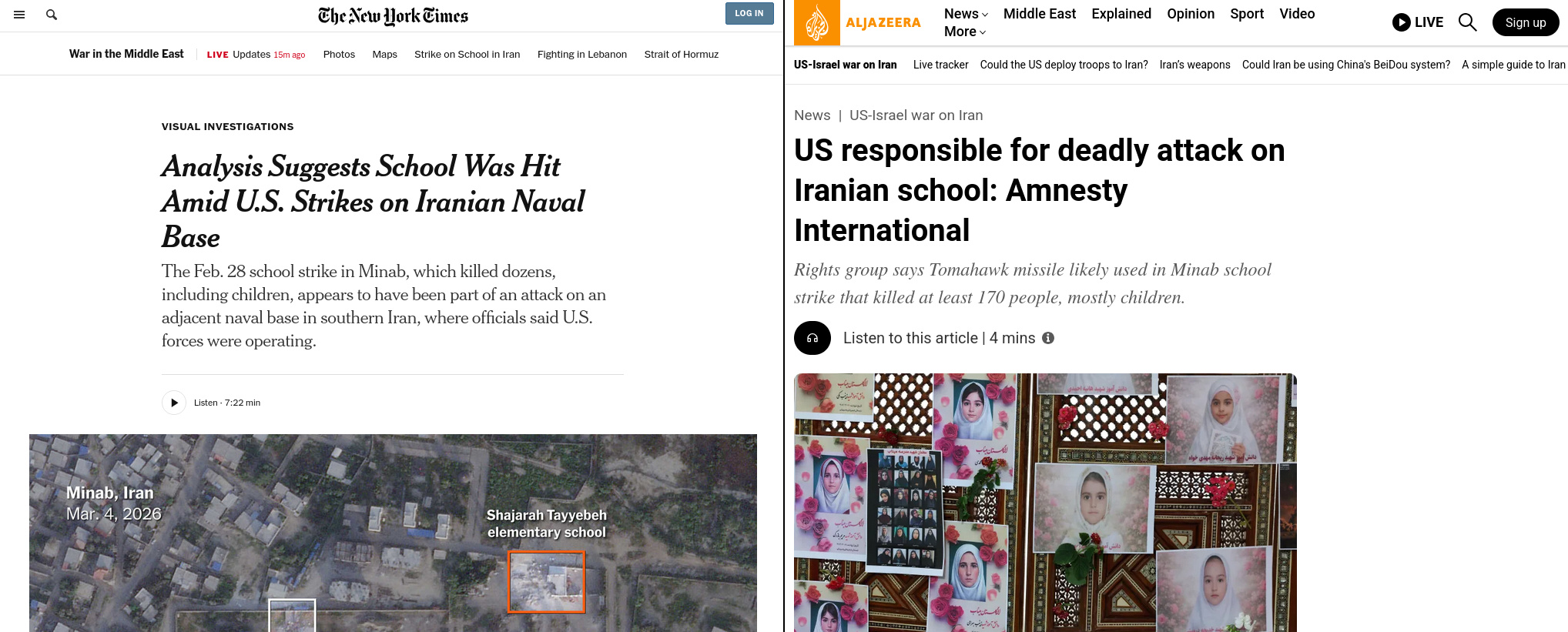
Both these articles are talking about the same event, but why does one have the word suggests instead of responsible? Why does one include the term dozens as if we were talking about baked goods and not children? We get nauseous at the mere thought of nuclear bombs or cyber attacks; however, it can be easy to overlook one of the most insidious weapons of war: language.
Language is dangerous
You may have never thought that deeply about participles and adjectives. However, language informs all aspects of our day-to-day living. Simple, seemingly innocuous parts of speech can become full-fledged weapons of war.
It is in the news articles and the memos, the social media captions, the tweets or twats (whatever we are referencing now). It is even in your everyday conversations. Language is ever-present and accessible to all. This accessibility ensures that kind, generous, and thoughtful folks use it for good, while corrupt, genocidal, and illogical riffraff can use it for evil.
See what I just did there? I used it. I placed a seed in your brain that paints a picture of a kind, generous, and thoughtful person. I used the word folks to trigger an image in your brain of friendly people. Maybe you pictured a loving set of grandparents who opened a bed and breakfast in their retirement. Maybe you saw a little house where they have interesting and respectful travelers stop in and try Grandma Pat’s famous meatballs. Then Grandpa Carlos insists they take a slice of pie for the road. How sweet. Folks just means people, but we typically use it with a tone of warmth or even affection.
Did you notice the other word, for the other kind of people, the dangerous ones? I didn’t even use a word that directly means people. Riffraff means “discarded or useless material.” With a single word, I implied they are unworthy of being categorized as human. Riffraff is a word we might use to describe trash that’s been tossed out on the side of the road, like a used napkin or a flaccid ketchup packet. One word stripped them of their humanity.
Historically, there is a well-established practice amongst riffraff to dehumanize entire populations, first through language, then through brutal actions that society minimizes or all-out denies centuries later. In the seventeenth and eighteenth centuries, phrases like “valuable slaves for sale” were common in advertisements, as though a humiliating and brutal ritual of inspection and eventual purchase of enslaved people were akin to promoting a sale at a hardware store.
In the 1970s, newspapers like the Washington Post made sure to include allusions to marijuana and communism when reporting about Vietnam War protests. For example, the 1971 headline, "End War Now, Throng Demands," characterizes protesters as a throng, which typically describes a crowd or congestion of people. It might be used to describe something chaotic, like a crowd rushing the stage at a concert. In this way, established newspapers did their diligence to promote the narrative that only hippies, stoners, and other agents of chaos protested the war.
The media we consume has evolved; it is no longer just newspapers and advertisements. It is YouTube and TikTok, Instagram and Facebook, and pretty much anyone with a somewhat stable internet connection can have a platform. This means the power of language is the most accessible it has ever been.
One moment, you might come across a teacher in Los Angeles sharing her pain for her immigrant students who have stopped coming to school because of raids from the masked gestapo. The next moment it’s an up-and-coming podcaster who celebrates how many illegals the brave agents have kicked out.
One of these examples uses a more human word alongside a jarring comparison to another familiar and horrific time. With one word, someone scrolling might start connecting the dots between history and present.
The other example also makes a brutal comparison. With one word they strip the humanity of an entire group of people, instead glorifying the people who are separating families. Someone might scroll past and fall into their dehumanizing rhetoric. Someone probably already has. Whether we like it or not, both examples likely have a growing following.
So let's spot the difference
One of these articles calls the U.S. responsible for the deadly bombing of a school where mostly children were killed. The other only suggests that a school was hit amid U.S. strikes on an Iranian naval base. One of these articles points a finger and says, “The U.S. bombed a school and killed children.” The other looks around nonchalantly and says, “It’s possible that maybe when the U.S. was logically bombing an Iranian naval base because that’s our number one enemy, a school was hit. By whom? Who knows?”
Now, take a look at the pictures. One article uses a picture of what appears to be a memorial, while the other shows a satellite image of a map showing buildings and dirt. While both articles might dive a little deeper into the horrific scenes and the obvious responsibility, the headlines reflect a calculated choice. Considering 54% of Americans have a literacy rate below the 6th grade, most readers likely won’t make it past the sensationalized headline.
Next time you find yourself scrolling on socials or skimming a news article, ask yourself questions about the language. Who wrote this? What is the meaning of this word, and what implications does it carry? What is their intention in adding this line? Who is being held accountable, and where is accountability withheld?
Language is a dangerous weapon. Yet, by understanding how it works and what the stakes are, you are in a better place to withstand the volleys.
And remember—it can be used for resistance, too.